
How to Improve Mental Toughness in Sports
Hence, normally when the subject of mental toughness in sports is brought up, the discussion starts from a position of confidence. Confidence. Positivity. Believing in oneself. Managing your emotions. Grasping the challenge. Commitment.
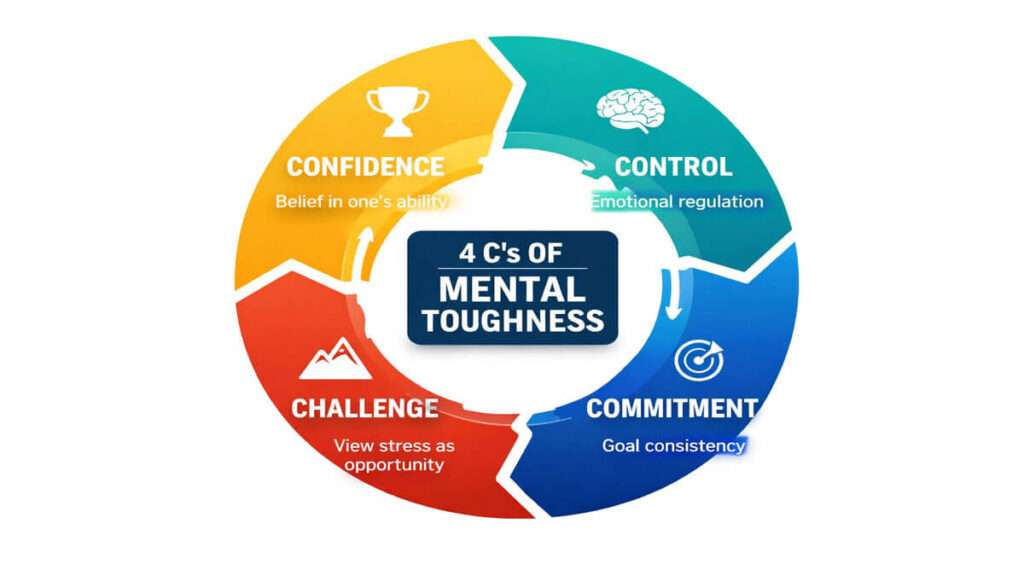
These ideas are not necessarily wrong. In fact, they are central to the ideas discussed through sports psychology’s 4 Cs model: confidence, control, commitment, and challenge. These ideas have helped numerous sportsmen understand what makes it to the next level.
And yet, something feels incomplete.
If mental toughness really is about increasing one’s performance in these four areas, then an athlete who inherently understands mental toughness components intellectually would perform at a high level during a game. However, this is far from the truth. Self-doubting occurs to disciplined and prepared athletes. Confidence decreases at the worst possible moment.
In that respect, the question is really about what fundamentally disrupts mental toughness.
And yet, something feels incomplete.
If mental toughness were simply about strengthening these four areas, then athletes who understand them intellectually would perform consistently under pressure. But that is rarely the case. Even disciplined, well-prepared athletes find themselves overthinking during important matches. Confidence disappears at the worst possible moment. Emotional control weakens when expectations rise.
So the question becomes more fundamental: what actually disrupts mental toughness in the first place?
The Hidden Problem Behind Performance Instability
The problem is often not a lack of confidence or commitment. The deeper issue is psychological interference.
Athletes do not compete only against opponents. They compete against their own internal narratives. Over time, they accumulate beliefs, fears, memories, labels, and expectations. They begin to identify with these mental structures.
“I am the strong one.”
“I cannot fail again.”
“I need to prove myself.”
“I must maintain my reputation.”
These thoughts appear normal. But the more tightly an athlete identifies with them, the more fragile performance becomes. Because now every mistake threatens identity. Every setback feels personal. Every moment of doubt feels dangerous.
Under pressure, this identification intensifies. Instead of responding fluidly, the athlete begins monitoring themselves. Attention divides. A part of the mind performs the task, while another part evaluates it.
That division is interference.
Why Building More Confidence Sometimes Backfires
Confidence is usually treated as the solution. Strengthen belief, and performance will follow. But confidence that depends on maintaining a certain internal state can easily collapse.
Consider how confidence is typically built. It often relies on past success, preparation, validation, and reinforcement. When these factors are stable, confidence feels solid. But competitive sports are unpredictable. Mistakes happen. Opponents adapt. Conditions change.
If confidence depends on constant validation, then doubt becomes threatening. The athlete begins trying to protect confidence. They push harder mentally. They attempt to silence fear. Ironically, this effort creates tension.
Instead of being immersed in the game, the athlete becomes preoccupied with preserving a mental image of themselves as confident.
That subtle shift is enough to disturb flow.
The 4 C’s Revisited With a Deeper Lens
The traditional 4 C’s — Confidence, Control, Commitment, and Challenge — describe valuable qualities. However, they operate within the psychological identity of the athlete.
Confidence levels may vary since it is linked to the self-image.
When the concept of control means controlling emotions, controlling can be draining.
Commitment lacks strength if motivated by fear of losing identity.
Threats feel challenging because self-worth is at stake.
None of these qualities develop until the athlete changes the ways they relate to their own brains.
And this is where de-identification becomes crucial.
De-Identification: Removing Psychological Interference
However, de-identification is not disconnection and being unbefriended. It is being aware that thoughts and feelings are experiences, but not identifications.
An anxious thought does not define the athlete.
A moment of doubt does not define ability.
A mistake does not define worth.
When an athlete fully merges with a thought — “I am losing control” — the nervous system reacts as if that thought is reality. But when the athlete notices the thought as an event — “The mind is producing fear right now” — something shifts.
There is space.
In that space, reaction slows down. Emotional intensity reduces. Attention begins to return to the task.
Research in cognitive science and attention training consistently shows that observing internal experience without over-identifying reduces rumination and enhances present-moment focus. Brain
networks associated with self-referential processing quiet down. Task-oriented networks become more dominant.
In practical terms, this means less overthinking and more responsiveness.
How De-Identification Strengthens Mental Toughness
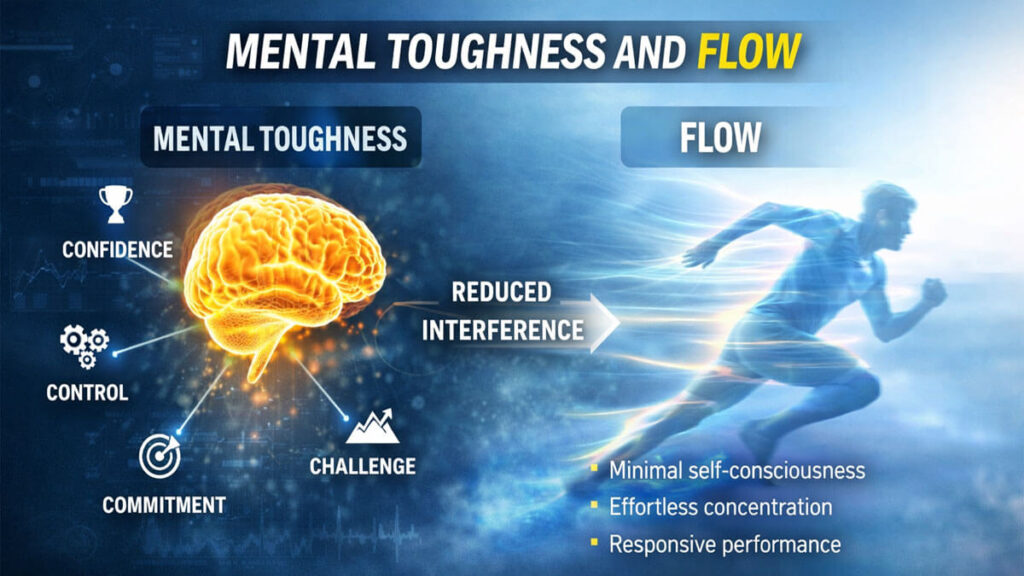
When psychological interference decreases, the qualities described in the 4 C’s stabilise naturally.
Confidence becomes less fragile because it is no longer defended. It is not something that must be constantly reinforced. It arises from clarity rather than mental force.
Control improves because emotions are not suppressed. They are allowed to arise without dictating behaviour. The athlete feels pressure but does not collapse into it.
Commitment becomes sustainable because it is no longer tied to proving oneself. Effort becomes process-oriented rather than identity-driven.
Challenge transforms into engagement. Pressure still exists, but it does not threaten the athlete’s sense of self.
Mental toughness, in this sense, is not constructed. It is uncovered when interference is reduced.
The Link Between Mental Toughness and Flow
Athletes often describe their best performances as moments when everything felt effortless. Time slowed down. Movement felt automatic. There was no internal dialogue interrupting action.
This is commonly referred to as flow.
Flow cannot be achieved by commanding the mind to be confident. It emerges when self-conscious thinking decreases. Studies on flow states indicate reduced activity in areas of the brain associated with self-monitoring and increased engagement in task-relevant networks.
That reduction in self-monitoring closely resembles de-identification.
When athletes are less entangled in their mental commentary, action becomes cleaner. Reaction speed improves. Decision-making sharpens.
In other words, improving mental toughness in sports is not only about resisting pressure. It is about creating the psychological conditions where flow becomes accessible.
Practical Training Beyond Motivation
If this sounds abstract, it becomes clearer in application.
One simple practice is structured observation. During training sessions, athletes intentionally notice recurring thoughts without attempting to eliminate them. Over time, this builds familiarity with internal patterns and reduces automatic fusion with them.
Another method is controlled exposure to error. Instead of immediately reacting emotionally to mistakes, the athlete pauses briefly to observe their internal response. This weakens identification with failure.
Breath regulation also supports this process by calming physiological arousal. When the body is stable, the mind becomes easier to observe.
None of these techniques aim to create artificial confidence. They aim to reduce interference.
And when interference decreases, performance stabilises.
Mental Toughness as Psychological Freedom
There is the general misconception that mental toughness requires mental rigidity: ‘harden thyself, squash doubt and be immoveable’.
But excessive rigidity breeds strain. In the long run, it sparks burnout or breakdown under extreme pressure.
True resilience is different. It’s flexible. It allows thought and emotion to move without getting trapped in them.
When athletes let go of built-up mental frameworks, aka past labels, expectations, successes, and failures, they perform beyond accumulated limitations.
Confidence no longer needs protection.
Control no longer requires suppression.
Commitment no longer depends on validation.
Challenge no longer threatens identity.
Performance becomes less about defending the self and more about engaging the moment.
Final Reflection
Improving mental toughness in sports is not simply about building a stronger mind. It is about reducing the dominance of the mind over performance.
The strongest athletes are often not those who think the most positively, but those who are least entangled in thought.
When psychological interference fades, attention sharpens. When identity loosens, flow becomes possible.
And from that psychological freedom, real mental toughness emerges.
For athletes who want structured guidance beyond theory, a dedicated sports mental toughness coaching program can help remove psychological interference at a deeper level.